6.s081 lab1 util
lab1
选择分支
git checkout util
Boot xv6
环境参考 lab0
sleep
为shell 添加一个可执行的 sleep 程序
在 xv6-labs-2020/usr 添加一个 sleep.c 的文件,作为 sleep 工具代码(用户态)
然后使用 user/user.h 的系统调用来执行 sleep 操作
#include "kernel/types.h"
#include "kernel/stat.h"
#include "user/user.h"

int main(int argc, char* argv[])
{
    if (argc != 2)
    {
        fprintf(0, "usage: sleep <number>\n");
        exit(1);
    }
    int number = atoi(argv[1]);
    sleep(number);
    exit(0);
}
最后要 exit(0); 不能 return
在 Makefile 添加
UPROGS=\
	$U/_cat\
	$U/_echo\
	$U/_forktest\
	$U/_grep\
	$U/_init\
	$U/_kill\
	$U/_ln\
	$U/_ls\
	$U/_mkdir\
	$U/_rm\
	$U/_sh\
	$U/_stressfs\
	$U/_usertests\
	$U/_grind\
	$U/_wc\
	$U/_zombie\
	$U/_sleep\
pingpong
为shell 添加一个可执行的 pingpong 程序
父进程 通过管道发送 ping
子进程通过管道收到ping之后 给父进程发送 pong
管道是单向的,为了实现父子进程双边通信,需要使用两个管道
#include "user/user.h"

int main(int argc, char const *argv[])
{

    int cp[2];
    int fp[2];
    pipe(cp);
    pipe(fp);
    int pid = fork();
    if (pid==0)
    {
        close(fp[1]);

        char ping[20];
        read(fp[0],ping,20);
        printf("%d: %s\n",getpid(),ping);

        close(cp[0]);
        char pong[20]="received pong";
        write(cp[1],pong,20);
        int status;
        wait(&status);
    }else{
      close(fp[0]);
      char ping[20]="received ping";
      write(fp[1],ping,20);


      close(cp[1]);
      char pong[20];
      read(cp[0],pong,20);
      printf("%d: %s\n", getpid(),pong);

    }
    exit(0);
    //return 0;
}
primes
递归筛选素数,findPrimes(int *array, int len) ,为递归方法,参数是一个数组和长度。
findPrimes 有一个父进程和子进程执行任务。
主进程->打印最小的数,过滤,用管道给子进程发送 新数组
子进程->收到新数组 递归调用 findPrimes()
#include "user/user.h"
#define NUMS 34
void findPrimes(int *array, int len);
int main(int argc, char const *argv[])
{
    int* array = (int*)malloc(NUMS * sizeof(int));
    for (int i = 0; i < NUMS + 2; i++)
    {
       array[i]=i+2;
    }
    findPrimes(array,NUMS);
    wait(0);
    free(array);
    exit(0);
}

void findPrimes(int *array, int len){
    if (len == 0){
        exit(0);
        //return;
    }
    if (len == 1 ){
        printf("prime %d\n",array[0]);
        exit(0);
    }
    int p[2];
    pipe(p);

    int pid = fork();

    if (pid == 0)
    {
        close(p[1]);
        // 2.1读取数组长度
        int curLen = 0;
        read(p[0], &curLen, sizeof(int));
         //2.2读取管道array
        int* curArray = (int*)malloc(curLen * sizeof(int));
        if (curArray==0)
        {
             printf("error curArray malloc\n");
        }

        if (read(p[0],curArray,curLen * sizeof(int)) != curLen * sizeof(int)) {
            printf("error read array\n");
            exit(-1);
        }
        close(p[0]); // 关闭读端
        findPrimes(curArray,curLen);
        free(curArray);
        exit(0);
    }else{
        close(p[0]);
        int min = array[0];
        printf("prime %d\n",min);

        int nextLen = 0;
        int* newArray = (int*)malloc(len * sizeof(int));

        if (newArray == 0) {
            printf("error newArray malloc\n");
            exit(-1);
        }
        for (int i = 1; i < len; i++)
        {
            if (array[i] % min != 0) {
                newArray[nextLen] = array[i];
                nextLen++;
            }
        }
        if (nextLen!=0)
        {
            //1.1管道发送array长度
            if (write(p[1], &nextLen, sizeof(int)) != sizeof(int)) {
                printf("error write length\n");
                exit(-1);
            }
            //1.2管道发送array
            if (write(p[1], newArray, nextLen * sizeof(int)) != nextLen * sizeof(int)) {
                printf("error write array\n");
                exit(-1);
            }

        }
        close(p[1]);


        //等待子进程
        wait(0);
        free(newArray);
    }
}
find
参考 ls.c 代码,ls是查询当前目录的所有文件
find.c 只需要在ls的基础上,找到输入的文件,如果是目录递归调用find
#include "kernel/types.h"
#include "kernel/stat.h"
#include "user/user.h"
#include "kernel/fs.h"

char* fmtname(char *path)
{
  static char buf[DIRSIZ+1];
  char *p;

  // Find first character after last slash.
  for(p=path+strlen(path); p >= path && *p != '/'; p--)
    ;
  p++;

  // Return blank-padded name.
  if(strlen(p) >= DIRSIZ)
    return p;
  memmove(buf, p, strlen(p));
  memset(buf+strlen(p), ' ', DIRSIZ-strlen(p));
  return buf;
}


//findName可能是目录名 或 文件名
void findFile(char *findName,char *path){
  char buf[512], *p;
  int fd;
  struct dirent de;
  struct stat st;

  if((fd = open(path, 0)) < 0){
    fprintf(2, "ls: cannot open %s\n", path);
    return;
  }

  if(fstat(fd, &st) < 0){
    fprintf(2, "ls: cannot stat %s\n", path);
    close(fd);
    return;
  }

  switch(st.type){
  //输入的path是文件直接打印出来
  case T_FILE:
    printf("%s %d %d %l\n", fmtname(path), st.type, st.ino, st.size);
    break;

  case T_DIR:
    if(strlen(path) + 1 + DIRSIZ + 1 > sizeof buf){
      printf("ls: path too long\n");
      break;
    }

    //path 复制到 buf
    strcpy(buf, path);
    p = buf+strlen(buf);
    //buf 最后加一个/ -> path/
    *p++ = '/';

    //读目录下面所有文件
    while(read(fd, &de, sizeof(de)) == sizeof(de)){
      if(de.inum == 0)
        continue;

      // 给 path/ 后面加上这个文件- > path/filename
      memmove(p, de.name, DIRSIZ);
      p[DIRSIZ] = 0;
      if(stat(buf, &st) < 0){
        printf("ls: cannot stat %s\n", buf);
        continue;
      }
      //buf 是 path/filename

      //只取最后的filename
      char *tmpfilename = buf;
      for (char *curP = buf; *curP != '\0'; curP++) {
        if (*curP == '/') {
            tmpfilename = curP + 1;
          }
      }
      //如果buf path/filename 是目录那么递归
      if (st.type==T_DIR){

        if (strcmp(tmpfilename,".")==0 || strcmp(tmpfilename,"..")==0)
        {
            continue;
        }

        //目录名比较
        if (strcmp(tmpfilename, findName)==0){
          //printf("%s %d %d %d\n",buf , st.type, st.ino, st.size);
          printf("%s\n",buf);
        }

        //递归
        findFile(findName,buf);
      }else if (st.type==T_FILE){

        //文件名比较
        if (strcmp(tmpfilename, findName)==0){
          //printf("%s %d %d %d\n",buf , st.type, st.ino, st.size);
          printf("%s\n",buf);
        }
      }
    }
    break;
  }
  close(fd);
  return;


}


int main(int argc, char *argv[])
{
  if(argc < 3){
    printf("miss parameters\n");
    exit(0);
  }
  char *findName = argv[2];
  char *findPath = argv[1];
  findFile(findName,findPath);
  exit(0);
}
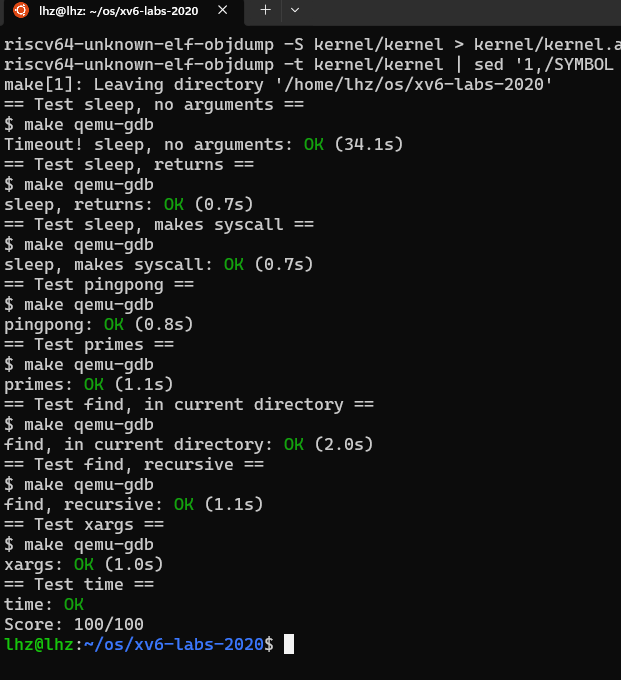
实验结果