6.s081 xv6-Schedule调度的实现
xv6-源码解析-Schedule
操作系统同有多个进程,但CPU只有一个,为了实现好像进程都在同时执行,时钟中断导致的当前进程让出CPU使用权 完成进程切换的调度过程,这就是调度。
调度原理
用户进程执行一段时间后,操作系统产生时钟中断,中断会从用户态切换到内核态,然后执行trap过程,调用usertrap 函数执行对应的中断处理程序,处理时钟中断会调用yield函数,让出CPU,进入调度(scheduler)线程,调度线程选择一个进程恢复到用户态运行。
void
usertrap(void)
{
  int which_dev = 0;
  if(r_scause() == 8){
    // system call
  } else if((which_dev = devintr()) != 0){
    // ok
  } else {
	// exception
  }

  if(p->killed)
    exit(-1);

  // give up the CPU if this is a timer interrupt.
  // 核心点:如果是时钟中断,则让出当前CPU的使用权
  if(which_dev == 2)
    yield();

  // 从用户陷阱中准备返回
  usertrapret();
}
yield
yield很简单,就是修改进程状态,然后调用 sched() ,重要的还是 sched()
进程的状态
UNUSED, USED, SLEEPING, RUNNABLE, RUNNING, ZOMBIE。
// Give up the CPU for one scheduling round.
void
yield(void)
{
  // 获取当前进程并上锁,加锁是为了保护进程状态结构体的访问互斥性
  // 防止在修改进程状态时导致的不变量临时为假的情况
  // 这个锁在scheduler中被释放(跨进程)
  struct proc *p = myproc();
  acquire(&p->lock);

  // 首先修改进程状态为RUNNABLE
  p->state = RUNNABLE;

  // 调用sched完成当前进程上下文的保存
  sched();

  // 进程再次返回时才可以释放之前持有的锁
  // 这个锁之前由scheduler函数获取,在这里释放(跨进程)
  release(&p->lock);
}
sched
sched实际调用的是swtch
void
sched(void)
{
  int intena;
  struct proc *p = myproc();

  intena = mycpu()->intena;
  swtch(&p->context, &mycpu()->context);
  mycpu()->intena = intena;
}
swtch (swtch.S)
进程执行需要依赖很多 callee 寄存器,这些 callee 寄存器构成了进程上下文(contxt)
struct context {
  uint64 ra;
  uint64 sp;

  // callee-saved
  uint64 s0;
  uint64 s1;
  uint64 s2;
  uint64 s3;
  uint64 s4;
  uint64 s5;
  uint64 s6;
  uint64 s7;
  uint64 s8;
  uint64 s9;
  uint64 s10;
  uint64 s11;
};
swtch 实际就把当前的进程寄存器保存起来,然后恢复上一个进程保存的寄存器
swtch:
        sd ra, 0(a0)
        sd sp, 8(a0)
        sd s0, 16(a0)
        sd s1, 24(a0)
        sd s2, 32(a0)
        sd s3, 40(a0)
        sd s4, 48(a0)
        sd s5, 56(a0)
        sd s6, 64(a0)
        sd s7, 72(a0)
        sd s8, 80(a0)
        sd s9, 88(a0)
        sd s10, 96(a0)
        sd s11, 104(a0)

        ld ra, 0(a1)
        ld sp, 8(a1)
        ld s0, 16(a1)
        ld s1, 24(a1)
        ld s2, 32(a1)
        ld s3, 40(a1)
        ld s4, 48(a1)
        ld s5, 56(a1)
        ld s6, 64(a1)
        ld s7, 72(a1)
        ld s8, 80(a1)
        ld s9, 88(a1)
        ld s10, 96(a1)
        ld s11, 104(a1)

        ret
scheduler
void
scheduler(void)
{
  struct proc *p;
  struct cpu *c = mycpu();

  c->proc = 0;
  for(;;){
    // Avoid deadlock by ensuring that devices can interrupt.
    intr_on();

    for(p = proc; p < &proc[NPROC]; p++) {
      acquire(&p->lock);
      if(p->state == RUNNABLE) {

          //选择一个RUNNABLE的进程,分配CPU,开始运行
        p->state = RUNNING;
        c->proc = p;
        swtch(&c->context, &p->context);

        // Process is done running for now.
        // It should have changed its p->state before coming back.
        c->proc = 0;
      }
      release(&p->lock);
    }
  }
}
调度流程图
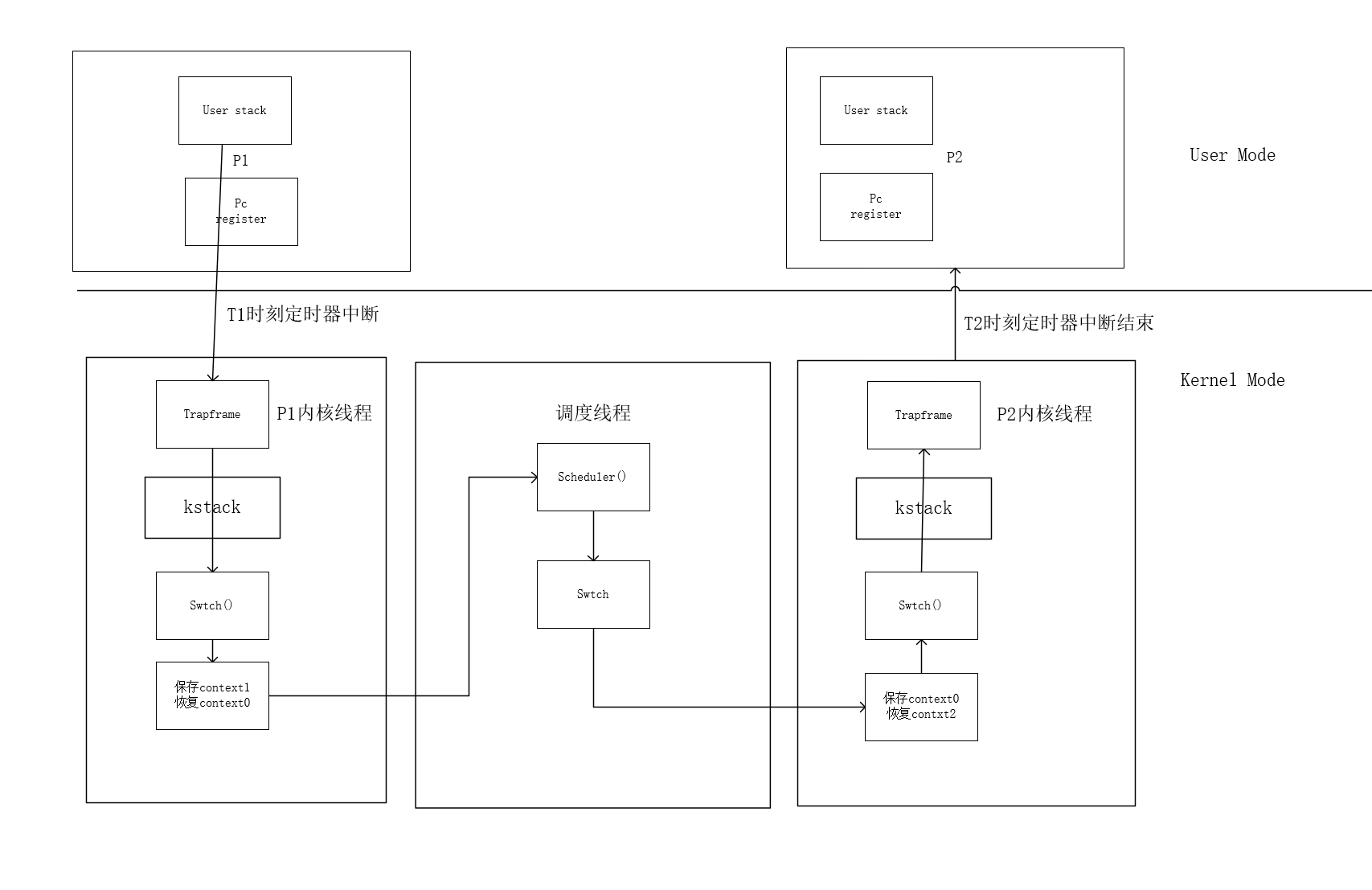
图1 P1切换到P2的流程
用户进程1
P1用户态执行的时候,T1时刻发生始终中断,通过trap过程进入P1的内核态,使用内核栈调用usertrap()函数。
再 usertrap 中调用 yield()->sched()-> swtch()函数,把当前进程的context保存在cpu的context中,恢复调度线程的contxt。(此时P1是停在了sched()的swtch()函数的下一行,也就是mycpu()->intena = intena)
调度线程
此时ra发生改变(之前cpu的contxt所保存的指令地址),会跳转到scheduler()函数里面,也就是c->proc = 0;这一行。
调度线程再循环中找到一个RUNABLE,就绪态的进程,调用swtch(),恢复P2的contxt,再ret到P2上次处理时钟中断的位置
用户进程2
也就是**用户进程1 **进入调度线程的入口下面 **mycpu()->intena = intena **这一行,然后再从yield()返回,回到用户态
void
sched(void)
{
  int intena;
  struct proc *p = myproc();

  intena = mycpu()->intena;
  swtch(&p->context, &mycpu()->context);
  mycpu()->intena = intena;
}
如果此时用户进程2执行一段时间发生时钟中断切换到P1 如下图红色线的流程,与上面一模一样
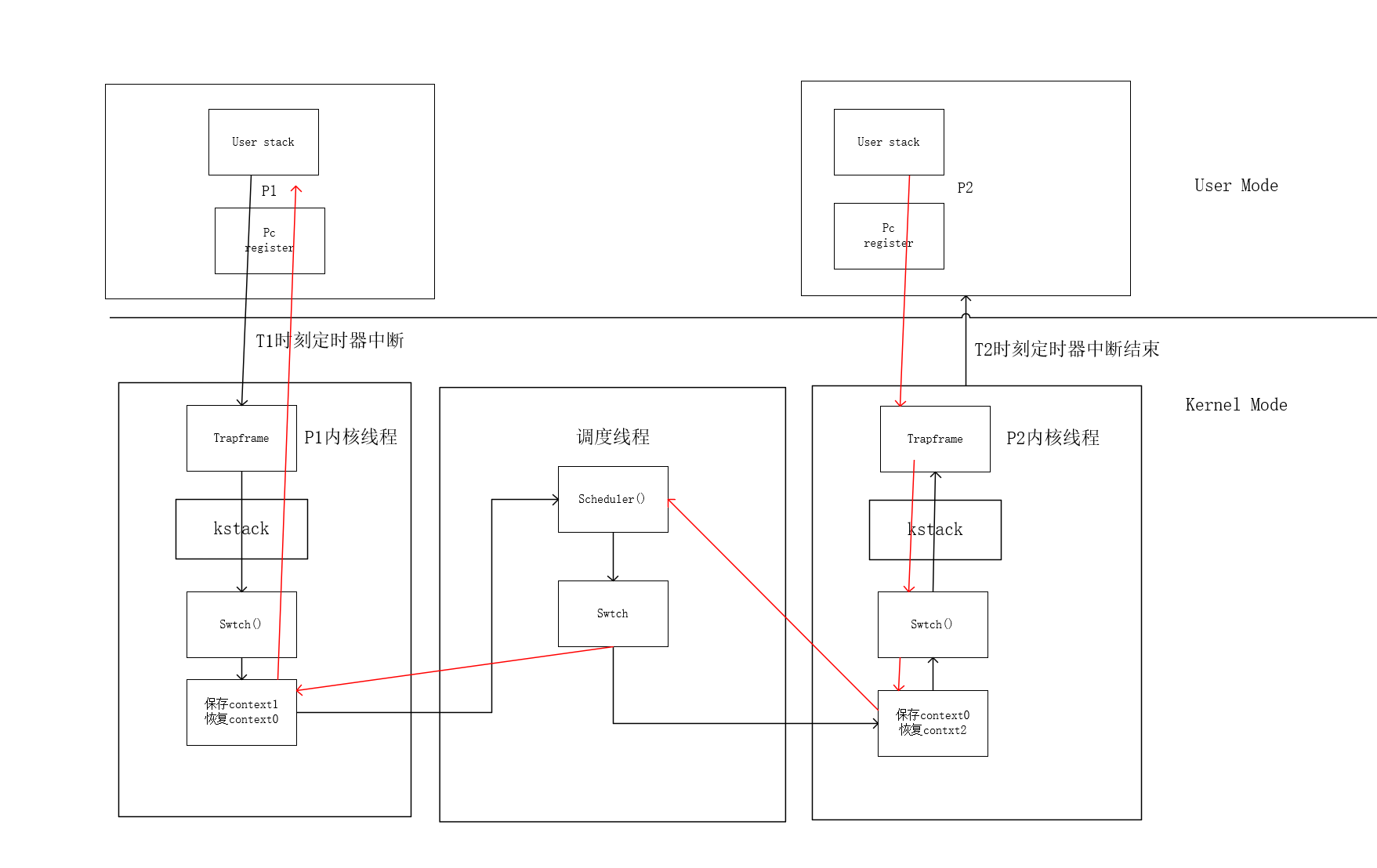
图2 P2切换到P1的流程